J1772 charging speed is not one fixed number. On a normal 120-volt outlet, a J1772 plug adds roughly 3 to 5 miles of range per hour. On a 240-volt Level 2 charger, the usual figure is about 25 miles of range per hour, and a Level 2 unit can deliver anywhere from 2.9 to 19.2 kW. iaeimagazine
Your own speed depends on three things: how much power the charger gives, how much power your car can accept, and the state of your battery. Let’s go through each one so you can work out your real number.
What is a J1772 connector?
J1772 is the standard round plug used for AC charging in North America. It handles Level 1 (120 volts) and Level 2 (240 volts) charging. It does not do DC fast charging on its own.
Some cars use a bigger port called CCS1. CCS1 is a J1772 connector with two extra pins added underneath for DC fast charging. A CCS port accepts a normal J1772 plug too, which is why one car can use both slow and fast chargers. cablematters
J1772 charging speed by level
| Level | Power supply | Typical speed |
| Level 1 | 120V household outlet | About 3–5 miles of range per hour |
| Level 2 | 240V (208V at some commercial sites) | About 25 miles of range per hour on average |
The U.S. Department of Energy’s Alternative Fuels Data Center says 8 hours of Level 1 charging adds about 40 miles for a mid-size EV. That is enough for a short daily commute, but not much more. iaeimagazine
High-amperage Level 2 stations, up to 80 amps, can add up to 60 miles of range per hour to a car that can accept that much power. Most homes and public stations are far below that. mass
J1772 amps and kW: a simple cheat sheet
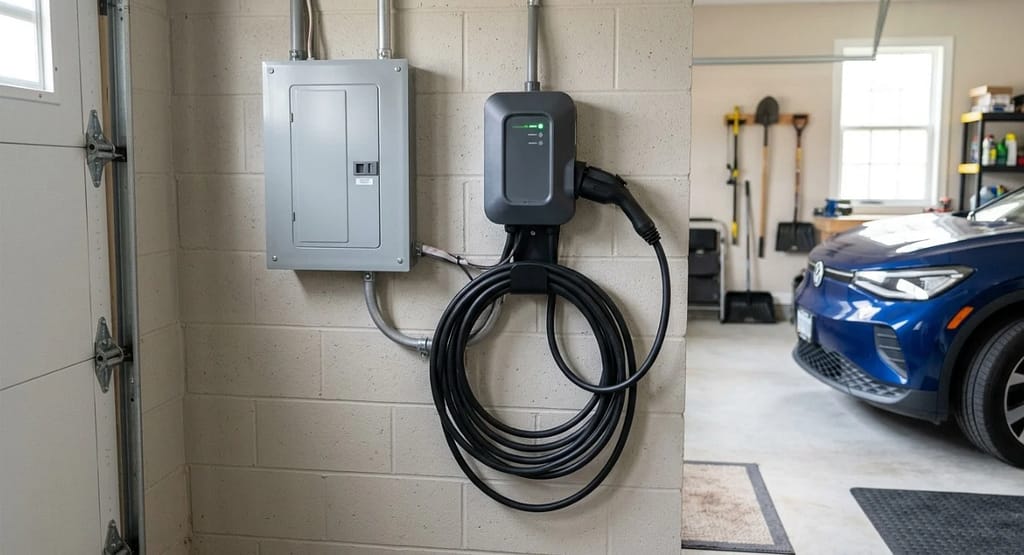
Power in kilowatts comes from volts times amps. At 240 volts, here is what common J1772 chargers deliver:
| Charger amps | Power at 240V |
| 16A | 3.8 kW |
| 24A | 5.8 kW |
| 32A | 7.7 kW |
| 40A | 9.6 kW |
| 48A | 11.5 kW |
As a rough guide, many EVs travel about 3 to 4 miles per kWh. So a 7.7 kW charger adds somewhere around 23 to 31 miles per hour. Your car’s efficiency will move this up or down.
Why your J1772 charging is slower than the charger’s rating
This is the part most guides skip. A “48A charger” does not always deliver 48 amps. Check these first:
1. Your car’s onboard charger. The car converts AC power to DC before it enters the battery, and that converter has a limit. Some vehicles accept only 3.3 kW, while others take 11.5 kW or more. A 11.5 kW charger plugged into a car that tops out at 7.2 kW will still charge at 7.2 kW. Look up your car’s maximum AC charging rate in the manual. ev-lectron
2. The circuit behind the charger. A charger can only pull what its circuit allows. One review notes that a plug-in charger on a 40A NEMA 14-50 outlet tops out around 38 miles per hour, while the hardwired version on a 60A circuit can use the full 48A. Home chargers usually run at 80% of the breaker size for long sessions, so a 40A breaker pairs with a 32A charger. An electrician should confirm this for your home. mayfairfarms
3. Public stations that limit power. Some J1772 stations can reach 19.2 kW, but most public networks cap output around 6.6 to 7.2 kW so several cars can share the supply. If a public charger feels slow, the cap is often the reason. ev-lectron
4. Your charger’s amp setting. Many home units let you choose the current. One portable 32A model, for example, offers settings of 16, 20, 24 and 32 amps. If someone set it low, the charger is doing exactly what it was told. Open the app or menu and check. 123securityproducts
5. Battery level and temperature. Charging is not linear. The fuller the battery gets, the slower the charge becomes. Cold or hot weather can also change speed. A car that starts at 20% will usually look faster than one at 85%. energyev-lectron
How to estimate your J1772 charging time
Use this simple formula:
Charging time (hours) = energy needed (kWh) ÷ charger power (kW)
Add a little extra, because some energy is lost as heat during charging.
Example: you want to add 30 kWh. Your car accepts 7.2 kW and the charger gives 7.7 kW, so the car is the limit. 30 ÷ 7.2 is about 4.2 hours. With losses, plan for a bit over 4 hours.
Here is a check against a real product listing: a 32A, 7.7 kW portable charger is listed as filling a 60 kWh battery from empty in about 8 hours. That matches the math, since 60 ÷ 7.7 is just under 8 hours. 123securityproducts
Can a J1772 plug do fast charging?
Not on its own. A J1772 plug supplies AC, so the car’s onboard charger does the work. DC fast chargers provide 50 kW to 350 kW, compared with 3.3 kW to 19.2 kW for J1772 Level 2. For road trips you need a CCS or Tesla fast charger. ev-lectron
Tesla owners can use J1772 chargers with an adapter. Charger makers also note that Tesla drivers will need a J1772 adapter for J1772-only home units. Speed is still limited by the charger and the car, not by the adapter. mayfairfarms
How to get the best J1772 charging speed
- Find your car’s maximum AC charging rate before buying a charger. Paying for 11 kW does nothing if the car stops at 7 kW.
- Match the charger to the circuit. Have an electrician check the breaker, wire size and outlet.
- If you use a plug-in unit on a NEMA 14-50 outlet, expect the lower power level. Hardwiring can allow more.
- Check the amp setting in the charger’s app or menu.
- At public stations, ask whether the site shares power between ports. Using a different port can help.
- Plug in when the battery is lower. The first half of charging is usually the fastest.
Safety note: wiring for a 240V charger is not a DIY job for most people. A wrong breaker or loose connection is a fire risk, so use a licensed electrician.
FAQs
How many kW is a J1772 charger?
J1772 Level 2 equipment ranges from about 2.9 kW up to 19.2 kW. Most home chargers sit between 7 and 11.5 kW. Level 1 is much lower, around 1.4 to 1.9 kW.
Is J1772 the same as Level 2?
No. J1772 is the plug type. It is used for both Level 1 and Level 2. Level 2 is the faster 240-volt option.
Why is my J1772 charger slow?
Common causes are a low onboard charger limit in your car, a low amp setting, a smaller circuit, a power-capped public station, or a nearly full battery. Check them in that order.
Does J1772 charge faster than Tesla’s plug?
The plug itself is not what decides speed. For AC charging, both are limited by the charger and the car. Tesla’s advantage is its DC Supercharger network, which J1772 alone cannot match.
How long does it take to charge an EV with J1772?
Divide the energy you need in kWh by the real charging power in kW. A 60 kWh battery on a 7.7 kW charger takes about 8 hours from empty. From half full, expect roughly half that.
The short version
J1772 charging speed comes down to the slowest link: the charger, the circuit, or your car’s onboard charger. Learn those three numbers and you can predict your charge time before you plug in.
About the Author