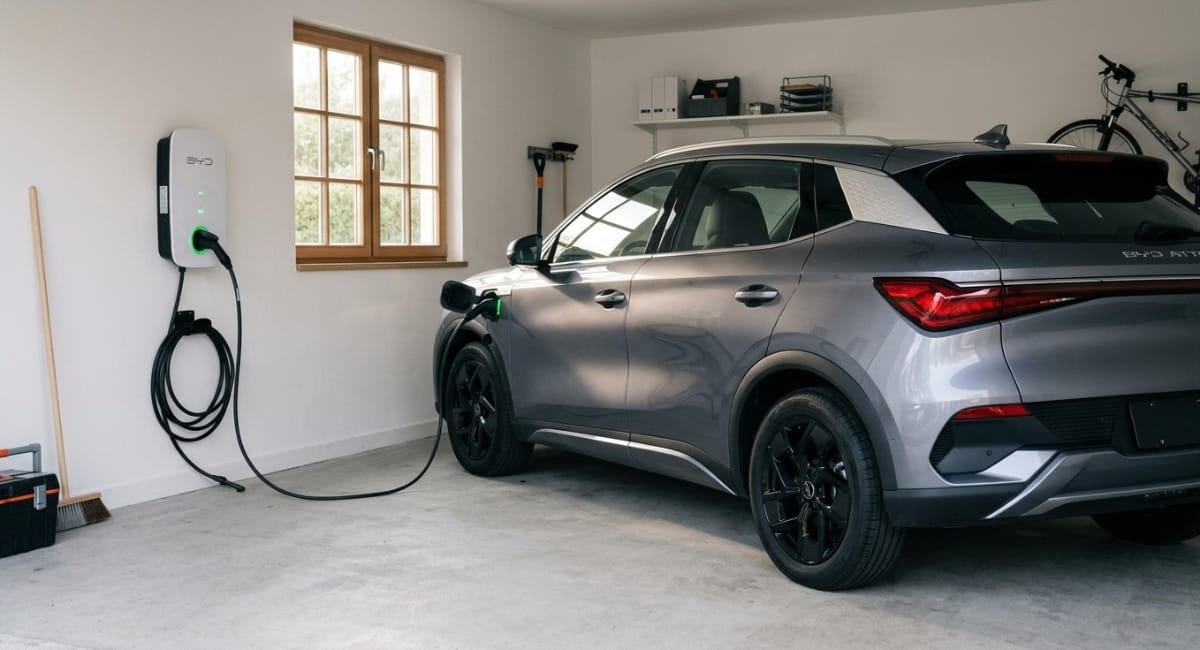
A BYD charger can mean three different things: a wall-mounted charger for your home, a portable cable you carry in the boot, or a public fast charger such as BYD’s new Flash Charger. For most owners, the right choice is a home AC charger with a Type 2 plug. It is simple, safe and fast enough for overnight charging.
This guide explains each type in plain words. It also covers charging speeds, plug types and a few mistakes that cost people time and money.
The three types of BYD charger
| Type | What it is | Best for |
| Home wallbox (AC) | A charger fixed to your wall | Daily charging |
| Portable charger | A cable that plugs into a wall socket | Backup and low-mileage days |
| Public DC fast charger | A large roadside or station charger | Long trips and quick top-ups |
AC means alternating current. Your home supplies AC, and the car turns it into battery power. DC means direct current. DC fast chargers skip that step, which is why they are faster.
BYD home charger: speed, size and features
BYD sells its own AC charger in some markets. The Australian version comes in 7kW single-phase and 11kW three-phase versions. The spec sheet also lists a smaller 3.5kW option. It has a 7.5-metre cable, an IP54 rating for dust and splashes, and a 3-year warranty. bydautomotivebydautomotive
One thing buyers often miss: the current retail version is plug-and-charge. It has no mobile app, no Bluetooth and no OCPP network function, though it does support RFID cards. If you want app control or solar tracking, you may prefer a third-party smart charger. bydautomotive
The charger is not the only limit. BYD says actual speed also depends on the car’s onboard charger, battery size, state of charge and your electrical installation. A small wiring supply will cap the speed even with a powerful wallbox. bydautomotive
How long does a BYD take to charge at home?
One Australian guide gives these approximate times on a 7 kW home charger: Atto 3 about 6–7 hours, Dolphin 5–6 hours, Seal 8–9 hours, and Sealion 7 about 11–12 hours. Treat these as rough guides, because battery size and model year change the result. evse
The same guide notes that most BYD models top out at 7 kW on AC, so a stronger charger will not make them faster. Check your own model’s AC limit before paying for a bigger unit. Some markets and variants differ, and other sources list 11 kW AC for the Atto 3. evse
Which plug does a BYD charger use?
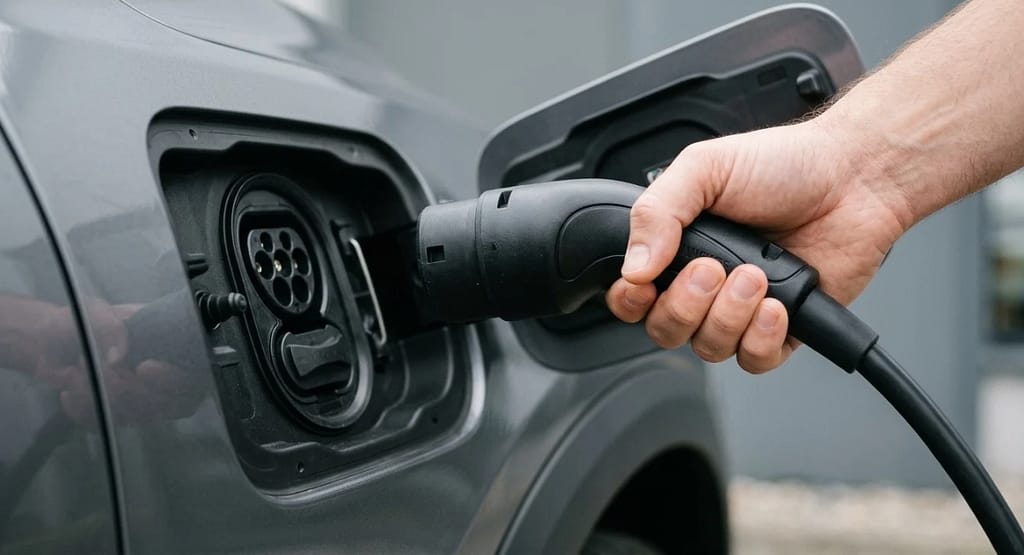
In markets like Australia, the UK and Europe, BYD cars use a Type 2 plug for AC charging. One accessory guide says every BYD electric model sold in Australia uses a Type 2 inlet. The same guide explains that DC fast chargers use CCS2, which is the Type 2 shape with two large DC pins added below. bydaccessoriesbydaccessories
A simple check: look at your car’s charging flap and your owner’s manual. Plug standards differ by country, so do not assume.
A common mistake is buying the wrong cable type. BYD uses Type 2, not the older Type 1. bydaccessories
Portable charger or wall charger?
A portable charger plugs into a normal socket. It is handy as a backup, but a wall charger is the better daily tool. One installer puts it plainly: a dedicated home charger is safer, faster and more convenient than a regular plug socket. Another guide says the cable supplied with the car is designed only for occasional use. smarthomechargeevse
If you rent or move often, a portable charger plus a licensed electrician check on the socket is a reasonable starting point.
BYD Flash Charger: what is true so far
BYD’s Flash Charger is the headline product. It can deliver up to 1,500 kW DC per connector and can take a battery from 10% to 97% in about nine minutes. A separate report quotes 10 to 70 percent in five minutes. carnewschinawarpnews
Here is the honest side of those numbers:
- These are best-case results. One report says the real peak is closer to 1,360 kW. driveteslacanada
- Only new BYD models with the second-generation Blade Battery can charge effectively at these chargers. Older cars, including many people’s current BYD, will charge much slower. carnewschina
- Rollout is still growing. BYD had built 6,682 flash chargers in 321 Chinese cities by mid-June 2026, against a target of 20,000 by the end of 2026. The first overseas units have appeared in Germany and the UK. carnewschinacarnewschina
So for now, Flash Charging is mostly a China story. Most owners elsewhere will still rely on home AC and ordinary public DC chargers.
Common BYD charging problems and what to check first
Slow DC charging in cold weather. One troubleshooting guide says the Atto 3 charges fastest between 10% and 50% and has no preconditioning. It suggests driving 30–45 minutes before a DC stop in cold weather. evcourse
Solar or scheduled charging not starting. Charge HQ reports that the Atto 3 does not wake from sleep when a charger offers power. That affects schedules and solar charging set on the wall charger. A workaround is to use the car’s own scheduler or wake the car manually. chargehq
Charger will not start at a public station. A “handshake” problem means the car and charger cannot talk to each other. This was reported in 2023 on some Tesla V3 sites for the Atto 3. Since compatibility changes over time, check a current charging app before relying on one network.
Slower than expected at home. Check the circuit, the charger setting and the car’s own charging limit before blaming the unit.
Before you buy a BYD charger: a short checklist
- Check your car’s AC charging limit (7 kW or 11 kW).
- Check if your home has single-phase or three-phase power.
- Choose plug-and-charge or smart features, depending on whether you want solar or tariff control.
- Book a licensed electrician. BYD’s own page says installation must be completed by a licensed electrician. bydautomotive
- Check local rules. BYD’s Australian page says its charger is not currently compliant in South Australia, so confirm approval where you live. bydautomotive
FAQs
Does a BYD come with a charger?
Most BYD cars include a portable charging cable. It is meant for occasional use, not as your main daily setup. A wall charger is usually sold separately.
Can I use a non-BYD charger?
Yes, if it has a standards-compliant Type 2 plug. BYD’s own charger page says its unit also supports other EVs with a Type 2 inlet, which shows the plug is a common standard. bydautomotive
What is the fastest BYD charger?
The Flash Charger, rated up to 1,500 kW. Only newer BYD models with the second-generation Blade Battery can use it well.
Can I charge a BYD from a normal wall socket?
Yes, with a portable Mode 2 cable, but it is slow. Use it as a backup, and have the socket checked by an electrician first.
Will an 11 kW charger make my BYD charge faster?
Only if your car accepts 11 kW on AC. If it is limited to 7 kW, the extra power is wasted.
The key takeaway
Start with the plug and your car’s AC limit. Then pick a wall charger that matches your power supply, and have a licensed electrician install it. Treat the Flash Charger as an exciting development for newer models, not a reason to change your home setup today.
About the Author