Well tank repair is possible only in some cases. If the tank just needs more air, you can fix it in under an hour. If a small part like the pressure switch is bad, it’s a quick swap. But if the rubber bladder inside has burst or the steel has rusted through, no repair will hold, and the tank has to be replaced.
The hard part is knowing which of these you’re dealing with. This guide walks you through it in plain steps, so you don’t spend money on the wrong fix.
What Does a Well Tank Actually Do?
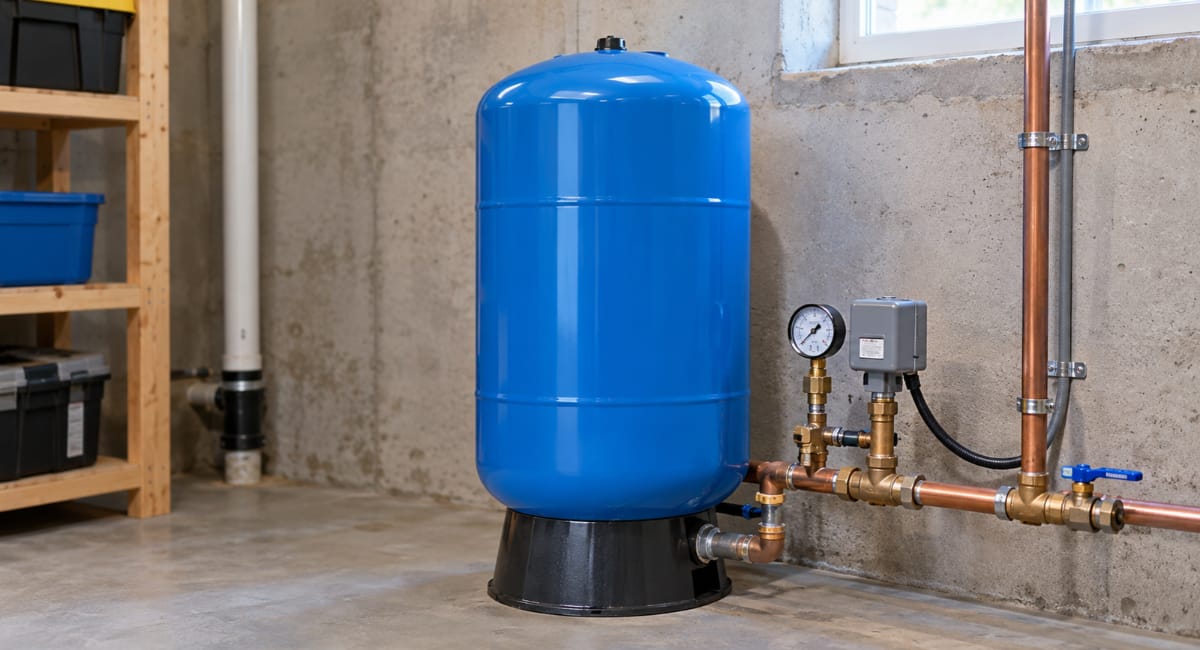
Think of it as a pressure cooker’s calmer cousin. Your pump pushes water into the tank. The air inside gets squeezed, and when you open a tap, that squeezed air pushes the water out.
The tank also protects your pump. Fresh Water Systems explains that it cuts down how often the pump must start and stop. When the tank stops working, the pump starts working overtime, and pumps are much more expensive than tanks.
7 Signs of a Bad Well Pressure Tank
You rarely see the tank fail. You notice what it does to your water. Watch for:
- Pressure that goes up and down, especially in the shower
- Taps that spit or pulse
- A pump that switches on and off every few seconds (this is called short cycling)
- Clicking from the pressure switch
- A pressure gauge needle that jumps around
- Water dripping from the air valve on the tank
- A higher electric bill than usual
Fresh Water Systems adds sediment, bubbles in the water and falling water output to the list.
Quick Guide: What’s Wrong and What to Do
| What you notice | Most likely cause | Usual fix |
| Tank sounds full all the way down when you knock | Waterlogged tank | Recharge air, or replace the tank |
| Water comes out of the air valve | Burst bladder | Replace the tank |
| Pump won’t switch off or on at the right pressure | Bad pressure switch | Replace the switch |
| Pump runs constantly, bill goes up | Failed check (foot) valve | Replace the valve |
| Leak from a rusty spot on the tank | Corrosion | Replace the tank |
| Pressure drops soon after you add air | Failing bladder | Replace the tank |
Check the Simple Stuff First
Before you blame the tank, do these three checks. Mr. Rooter recommends the same starting point.
- Is the main water valve fully open? It sounds silly, but it happens.
- Is water leaking somewhere? Even an underground leak makes the tank work harder.
- What does the gauge say? Mr. Rooter puts normal well pressure between 40 and 60 psi. Len The Plumber says many wells run between 30 and 50 psi. The setting is usually printed on the pressure switch itself.
A lot of people replace a good tank because the real problem was a leak or a tired switch. Spend ten minutes ruling those out first.
How to Tell if Your Well Tank Is Waterlogged
“Waterlogged” means the tank has too much water and not enough air. Without air, there is nothing to squeeze, so the pressure can’t stay steady.
Try the knock test. Tap the tank with your knuckles from top to bottom. A tank with air sounds hollow. According to Fresh Water Systems, a tank full of water gives a dull thud instead.
Check the air valve. It looks like the valve on a bicycle tire. If water comes out when you press it, the bladder inside has burst.
How to Repair a Waterlogged Well Tank (Bladder Type)
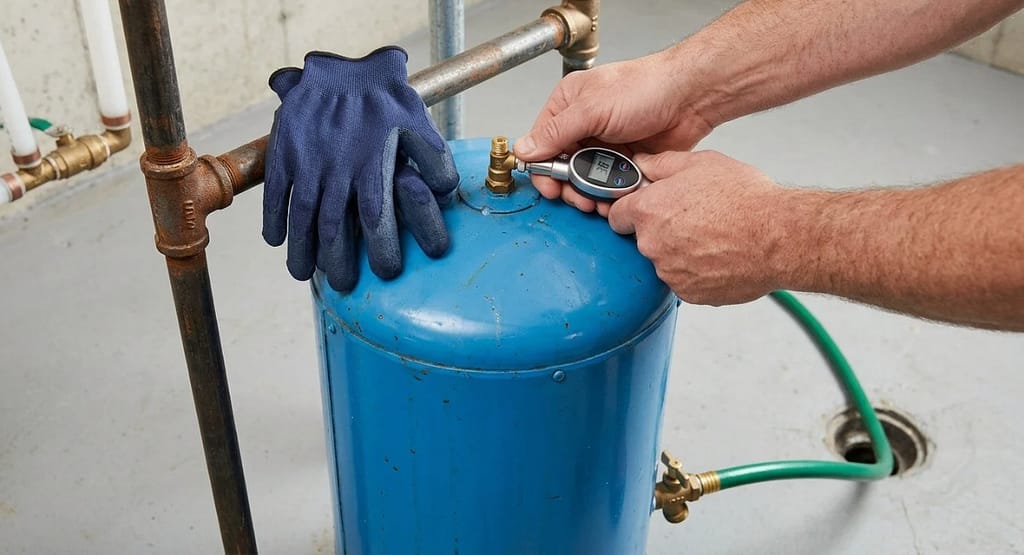
Most tanks today have a rubber bladder or diaphragm inside. Hunker says most of these can’t be repaired, but a quick attempt is worth it. It can work if the bladder is simply stuck in a strange position and isn’t torn.
Stay safe: Switch off the pump at the breaker first. Never add air above the maximum pressure printed on the tank’s label.
- Cut the power to the pump so it can’t start while you work.
- Bypass your water filter, if you have one. Draining can stir up sludge that clogs it.
- Drain the tank with a garden hose from the drain at the bottom. Run the hose outside, not into the house.
- Check the air pressure at the valve on top with a tire gauge. Hunker says an empty tank should read about 28 to 30 psi. Add or release air to match.
- Power back on. Run a tap until the water flows clear, then switch your filter back on.
What air pressure should a well tank have?
Set it 2 psi below the pump’s cut-on pressure, with the tank empty and the pump off. Fresh Water Systems gives this example: with a 30/50 switch, the tank should be at 28 psi. By the same rule, a 40/60 switch means 38 psi.
Here is a mistake people make a lot: they check the air while water is still in the tank. The reading is only right when the tank is empty.
If the pressure is gone again within a few days, the bladder has most likely failed. Fixing it again won’t help.
What About Older Air-Over-Water Tanks?
Some older tanks have no bladder. The air sits right on top of the water, and over time it slowly dissolves into it. Hunker says that for these tanks, adding air is sometimes all it takes. With fewer moving parts, they are often easier to bring back than bladder tanks.
It Might Not Be the Tank: Switch and Check Valve
Sometimes the tank is fine and a nearby part is the culprit.
Pressure switch. This tells the pump when to start and stop. Fresh Water Systems says the part itself costs about $20 to $40, and around $120 to $175 with labor.
Check valve (foot valve). It stops water from running back down the well. When it fails, the tank keeps emptying and the pump never rests. The same source lists about $20 to $40 for the part and $150 to $250 with labor.
Both guides suggest hiring a professional for these. A bad installation can damage the pump and tank.
How Much Does Well Tank Repair Cost?
It depends on the problem:
- Air recharge: often just your time and a tire gauge, plus a compressor if you don’t have one.
- Pressure switch: roughly $120 to $175 installed, per Fresh Water Systems.
- Check valve: roughly $150 to $250 installed, per the same source.
- New tank: prices vary a lot with size, brand and your area, and the figures I found online disagreed widely. Get at least two local quotes and ask what’s included.
When to Replace the Well Tank Instead
Stop repairing and replace when:
- water leaks from the air valve
- the tank leaks from a rusted patch (InspectAPedia says a badly rusted, leaking tank needs replacement, not repair)
- the air pressure keeps dropping after you recharge it
- the tank is old. WaterFilterGuru gives about 15 years as an average lifespan
Can you replace just the bladder?
Sometimes. Hunker notes that a few tanks allow it, but most do not. Fresh Water Systems says the bladder in most tanks isn’t replaceable at all. Check your tank’s manual first. Often a new tank is simpler and more reliable than hunting for parts.
What Happens If You Ignore It?
A failing tank doesn’t stay a small problem. Fresh Water Systems warns of water hammer (banging pipes), higher power bills and early pump failure. WaterFilterGuru adds that a pump that keeps short cycling can overheat and burn out its motor. Fixing the tank early is almost always cheaper than replacing the pump later.
When to Call a Professional
Call someone who knows wells if the tank is rusted or leaking, if water comes out of the air valve, or if you’re not comfortable around the electrical side. Also call if the pressure problem returns after a recharge, since the cause may be the pump or the check valve. Ask for a written quote, so you can compare prices.
FAQs
What causes a well tank to go bad?
Fresh Water Systems names three common causes: wear from long use, corrosion from poor water quality, and a failing pressure switch. A yearly check helps you catch problems early.
How long does a well pressure tank last?
About 15 years on average, according to WaterFilterGuru. Water quality and how hard the system works can shorten or extend that.
Why does my well pump keep turning on and off?
That’s short cycling. The usual cause is a tank that can’t hold pressure, often a waterlogged one. A faulty pressure switch can cause it too.
What should the air pressure in my well tank be?
Set it 2 psi below the pump’s cut-on pressure, with the tank empty and the pump off. For a 30/50 switch, that’s 28 psi.
Is it worth repairing an old well tank?
If a simple air recharge fixes it and the pressure holds, yes. If the tank is rusted, leaking or the bladder has burst, replacing it is the smarter choice.
The Key Takeaway
Start small. Check the valve, look for leaks, read the gauge, then test the air with the tank empty. If a recharge holds, you’ve saved yourself a lot of money. If water leaks from the air valve, the tank is rusting, or the pressure keeps vanishing, repair is the wrong goal. A new tank protects your pump and your water supply.
About the Author