Car batteries are DC (direct current). Every battery stores and releases power as DC, and a car battery is no exception. AC (alternating current) does exist inside a car, but only in one place: the alternator. The alternator turns it into DC before it reaches the battery.
Let’s look at why, and what it means for you.
AC vs DC: The Quick Difference
Both words describe how electric current flows.
- DC (direct current) flows in one direction only. It is steady. Batteries, solar cells and fuel cells give DC.
- AC (alternating current) keeps reversing direction. This is what comes out of the wall sockets in your home.
NAPA’s guide explains that AC travels farther, which is why power companies use it. DC gives a more consistent voltage, which is why electronics prefer it.
Why a Car Battery Is DC
A car battery is a chemical storage box. Inside, a chemical reaction pushes electric charge in one direction, from the negative terminal to the positive one. That one-way flow is DC by nature. The battery cannot produce AC, because it has nothing that reverses the flow.
Cars also use DC because almost everything in them is built for it: the starter motor, lights, fuel pump, radio, and the car’s computers. Steady voltage keeps them safe and predictable.
You can see this on the battery itself. It has a fixed positive (+) and negative (−) terminal. AC has no fixed positive or negative side.
Is a 12V Car Battery AC or DC?
It is DC. The “12V” only tells you the voltage (the strength of the push). It says nothing about the type of current. Most regular cars use a 12V battery, and it supplies DC.
So Where Does AC Show Up in a Car?
This is the part most short articles skip, and it is the reason people get confused
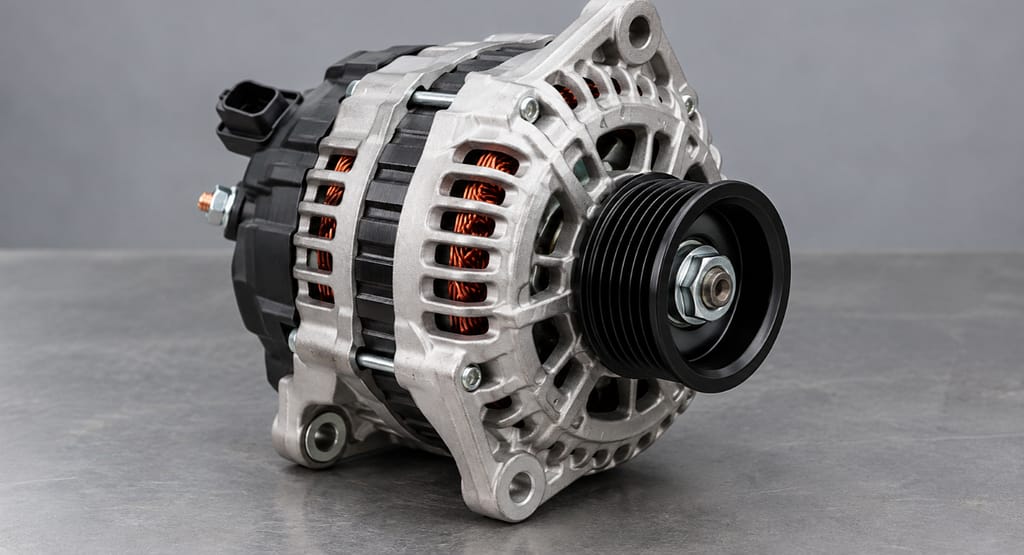
The alternator makes AC. When the engine runs, a belt spins the alternator. The spinning magnets inside it naturally create AC. But the battery and the car’s electronics need DC, so the alternator has a built-in part called a rectifier. It uses small parts called diodes, which work like one-way valves. They turn the AC into DC before the power leaves the alternator.
The flow is simple:
- Engine spins the alternator.
- Alternator makes AC.
- Rectifier changes AC to DC.
- Regulator keeps the voltage steady.
- DC charges the battery and runs the car.
A mistake you will see on some websites is the claim that the alternator “converts DC into AC.” It is the other way around. AC is made first, then converted to DC.
What Voltage Should a Healthy Car Battery Show?
Voltage is a quick health check. According to Agriland’s guide to alternators, a fully charged battery sits just over 12.6V, and it needs about 13.8 to 14.4V to charge while the engine runs. Below about 13.7V, charging is slow or may not happen. Above about 14.5V, a lead-acid battery can start to boil, which is dangerous and damages it.
How to Check It With a Multimeter
You can do a basic check at home. Be careful and keep metal tools away from the terminals.
- Set the multimeter to DC voltage (the V with a straight line, not the wavy line).
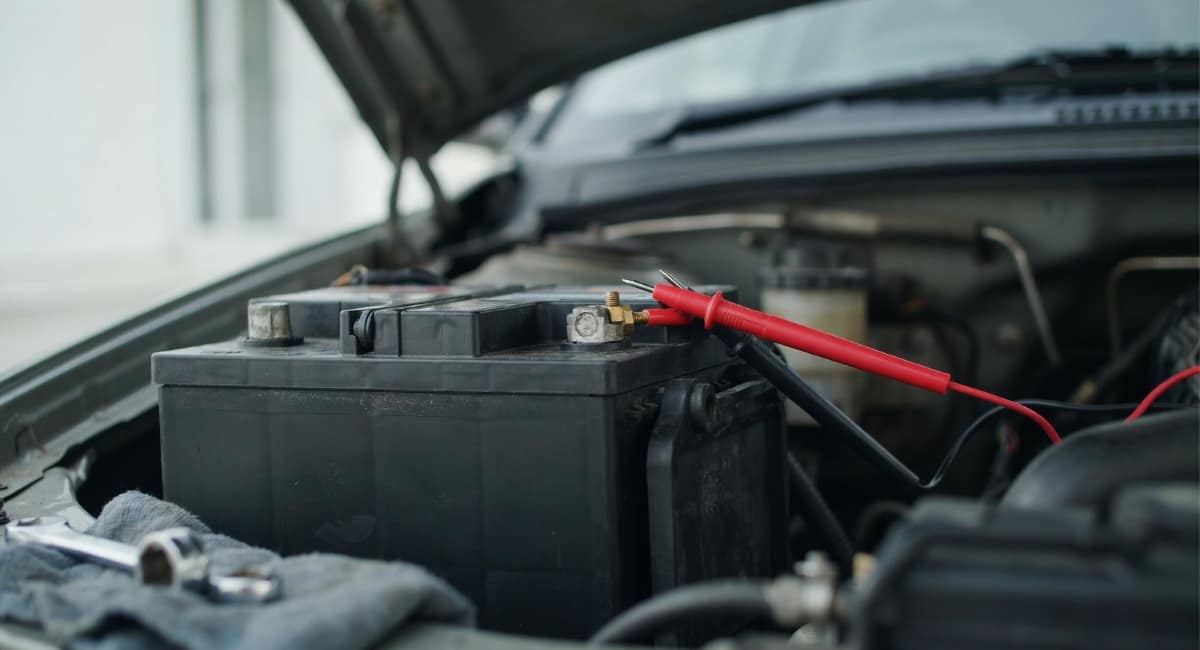
- With the engine off, touch red to the positive (+) terminal and black to the negative (−). A healthy, charged battery should read a little over 12.6V.
- Start the engine and measure again. You should see roughly 13.8 to 14.4V.
A useful tip: if a battery keeps going flat overnight, the alternator’s diodes may be failing and leaking power. Agriland notes that with the engine running, an AC voltage check at the battery should read close to zero. A clearly higher reading points to a diode problem.
Common mistake: people set the meter to the wrong mode, get a strange number, and think the battery is bad. Always check the mode first.
Can You Charge a Car Battery With AC?
Not directly. Never connect household AC to a car battery or the car’s wiring. The system is built for DC, and raw AC can cause serious damage.
A battery charger is safe because it has a transformer and rectifier inside. It takes the AC from the wall and turns it into low-voltage DC before it touches the battery.
Can a Car Battery Run AC Appliances?
Not by itself. If you want to run a laptop charger or a small tool in the car, you need a power inverter. It changes the battery’s 12V DC into AC. Check the inverter’s watt rating before use, and remember it draws from the battery, so don’t run it for long with the engine off.
Are Electric Car Batteries AC or DC?
Also DC. An electric car’s large battery pack stores DC. But the drive motor usually runs on AC, so an inverter changes the battery’s DC into AC to run it. Patent documents describing electric drive systems also show a DC-DC converter that steps the high voltage down to charge a separate 12V auxiliary battery. That small battery runs lights, screens and other accessories, and it is DC too.
FAQs
Is a car battery AC or DC?
A car battery is DC. It stores chemical energy and releases it as a steady, one-way current.
Does a car battery produce AC at any point?
No. Only the alternator produces AC, and it converts that to DC before charging the battery.
Why does my car need DC?
The starter motor, lights, sensors and computers are designed for steady DC voltage. AC would make the system more complex and could damage parts.
Can I use a car battery to power my home appliances?
Only through a power inverter that converts 12V DC to AC. Use one rated for the appliance’s wattage, and don’t drain the battery completely.
Is a car’s cigarette lighter socket AC or DC?
It is DC, at the same 12V as the battery. That is why plug-in car chargers are built as DC devices.
Are hybrid and electric car batteries AC or DC?
Both store DC. The car’s inverter changes it to AC for the motor when needed.
The Key Takeaway
Your car battery is DC always. AC only appears briefly inside the alternator and is converted straight back to DC. If you remember that, tests, chargers and inverters all become easier to understand. When in doubt, set your multimeter to DC and read the voltage.
About the Author