If you have ever typed “is car dc or ac” into a search box, here is the short answer. A car runs on DC, which means direct current. The battery gives DC power, and the wires, lights, radio and computers all use DC.
The one part that makes AC is the alternator. It makes AC inside, then a built-in part called a rectifier turns it into DC before the power leaves the alternator. So the car’s power is DC where you can use it.
This guide explains each part in plain words, including electric cars, inverters and what to set on your multimeter.
Is a Car DC or AC? Quick Reference
| Part | Type of current |
| 12V car battery | DC |
| Alternator (raw output inside) | AC |
| Alternator (after the rectifier) | DC |
| Car lights, radio, sensors, computers | DC |
| Home wall socket | AC |
| Plug-in battery charger (output) | DC |
| Inverter (output) | AC |
| Electric car battery | DC |
AC and DC in Simple Words
Electric current is a flow of charge through a wire. The difference is in the direction.
- DC (direct current) flows one way only. A battery works like this. It has a fixed positive end and a fixed negative end.
- AC (alternating current) flips direction again and again. The sockets in most homes supply AC.
Think of DC as water in a hose flowing one way. AC is like water pushed back and forth very fast.
Why a Car Battery Is DC
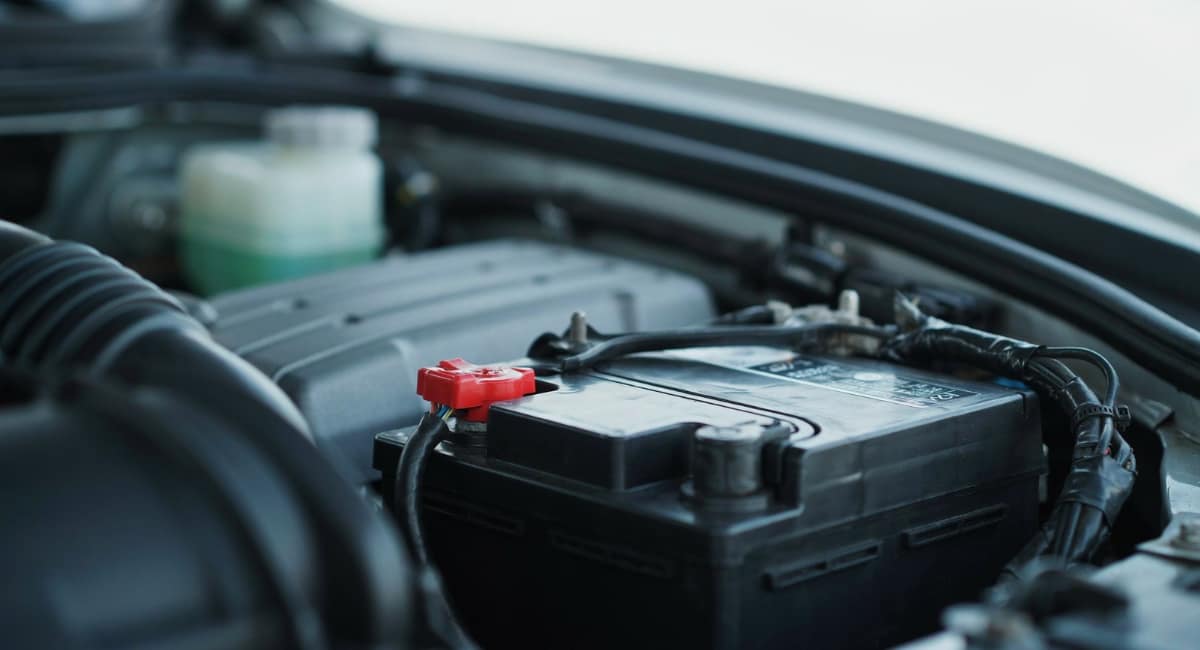
A battery makes electricity through a chemical reaction. That reaction creates a push between two terminals, positive and negative. The terminals never swap roles, so the current always flows one way. That is DC.
The car’s parts are built around this. The starter motor needs a strong burst of DC to turn the engine. Lights, sensors and control units also expect steady DC.
You may know it as a “12V battery”, but 12V is only the nominal (labelled) voltage. A healthy lead-acid battery at rest often reads about 12.6V to 12.8V. With the engine running, many cars show roughly 13.5V to 14.8V, because the alternator is charging. The exact number changes with temperature, battery condition and how much power the car is using.
Why Does the Alternator Make AC If the Car Runs on DC?
This is where most of the confusion starts.
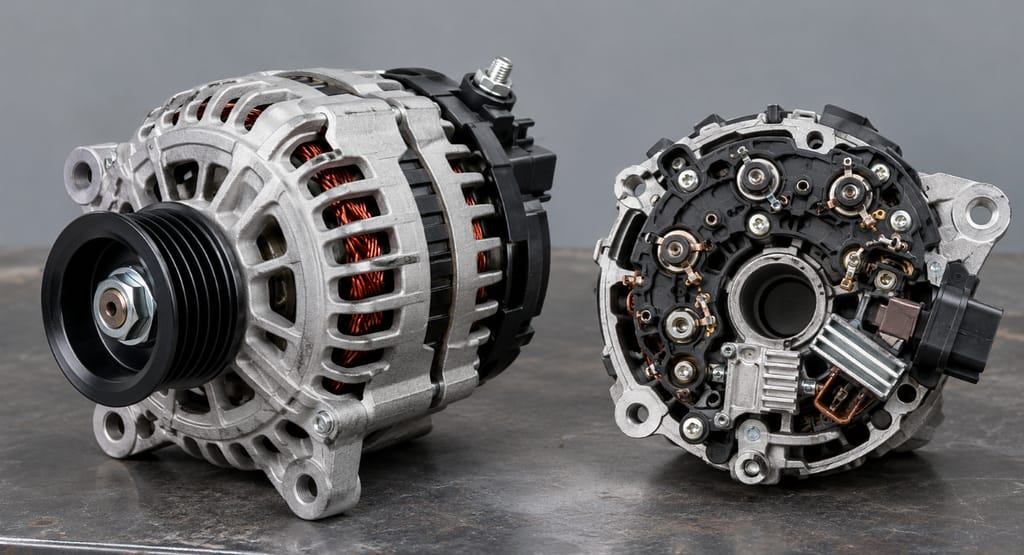
The alternator is driven by the engine’s belt. Inside, a spinning magnet makes electricity in coils of wire. Spinning a magnet past a coil naturally gives AC.
Then two things happen:
- A rectifier (a set of diodes) changes the AC into DC.
- A regulator keeps the output steady, even when the engine speed changes.
The path looks like this:
Engine → Alternator → AC → Rectifier → DC → Battery and car
Older cars used a generator that made DC directly. Alternators replaced them because they are lighter, simpler and tougher. Even with the rectifier added, they are the better choice.
A small warning: some websites say the alternator turns DC into AC. That is backwards. The alternator makes AC and the rectifier turns it into DC.
Is “Car AC” the Same as Alternating Current?
No. This trips up many people.
On your dashboard, A/C means air conditioning. It is about cooling the cabin. It has nothing to do with alternating current. The air conditioning controls and fan still run on the car’s normal 12V DC power.
So when you read “is car AC or DC” in a search result, check which “AC” the page is talking about.
Are Electric Cars AC or DC?
Electric cars follow the same rule, with more steps around the battery.
- The big battery is DC. It stores and supplies direct current.
- Charging at home or on a slow public charger (AC charging): the grid gives AC, and a part inside the car called the onboard charger converts it to DC for the battery.
- Fast charging (DC fast charging): the charging station does the conversion outside the car and sends DC straight to the battery. This is why DC chargers can be much faster than the car’s own onboard charger.
- The motor: many EV motors run on controlled AC. A part called an inverter changes the battery’s DC into AC for the motor.
So an EV is DC in the battery, with AC showing up at the wall socket and often at the motor.
How to Check With a Multimeter
A mistake I often see is people setting the meter to AC when testing a battery. For a car battery, use the DC voltage setting. It is usually marked with a V and a straight line (a dashed line under it). Put the red probe on the positive terminal and the black probe on the negative.
Here is a rough guide for a battery that has rested for a while:
| Resting voltage | Rough meaning |
| 12.6V to 12.8V | Fully or nearly full |
| About 12.4V | Partly discharged |
| About 12.2V | Around half charged, so recharge it |
| About 12.0V or less | Heavily discharged |
Treat these as a guide only. Cold weather, a recent drive or an old battery can change the reading. If the numbers look low, get the battery and alternator tested properly.
A technician may use the AC setting for one reason: to check for “ripple” from the alternator. A bad rectifier can leave some AC in what should be smooth DC. That is a test of the alternator. It does not mean the battery is AC.
Can a Car Battery Run AC Appliances?
Not directly. Wall-socket appliances expect AC, and the battery gives DC. You need an inverter in between:
12V DC battery → Inverter → AC → Appliance
Be careful with the size of the load. At 12V, a 600W appliance pulls about 50 amps from the battery, before inverter losses. That is a lot of current for cables, fuses and the battery itself.
Two safety points:
- Never connect household mains power straight to a car battery. It can cause shock, fire, arcing and battery damage. Use a proper charger, which takes AC in and gives controlled DC out.
- A starter battery is built for short, strong bursts, not long, deep draining. Running an inverter for hours can leave you unable to start the car. For long runs, such as camping, a separate deep-cycle battery is the better choice.
Frequently Asked Questions
Is a car battery AC or DC?
A car battery is DC. Its positive and negative terminals stay fixed, so the current flows one way.
Is a car alternator AC or DC?
Both, in different places. It makes AC inside, but a rectifier turns that into DC before it reaches the battery and the rest of the car.
Why do cars use DC and not AC?
Batteries can only store and supply DC, and the starter motor and electronics are designed for it. If a car used AC, each part would need its own conversion, which adds cost and complexity.
Are electric cars AC or DC?
The battery is DC. Home charging sends AC to the car, and the onboard charger converts it. Fast chargers send DC straight to the battery. The motor often runs on AC from an inverter.
Can I jump-start a car with an AC power source?
No. A jump-start joins two DC batteries. Household AC must never be connected to a car battery. To charge a battery at home, use a charger made for it.
Does the A/C button in my car use AC power?
No. A/C there means air conditioning. It runs from the car’s 12V DC system.
The Key Takeaway
A car is DC. The battery is DC, the wiring is DC and the electronics are DC. AC appears in only a few places: inside the alternator before the rectifier, at your wall socket, and at the motor in many EVs. If you remember that one rule, the rest makes sense. Use the DC setting on your multimeter, and use an inverter or a proper charger whenever AC and DC have to meet.
About the Author